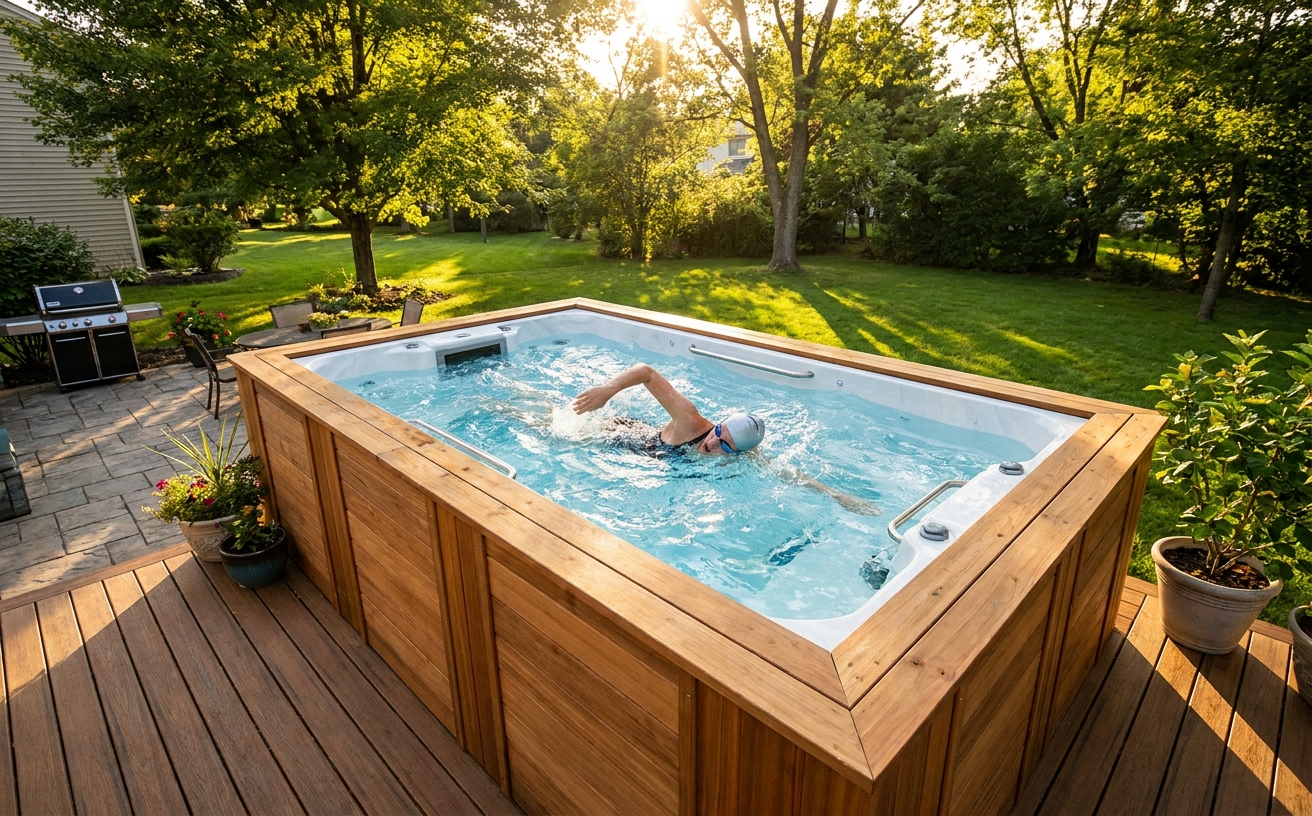
A swim jet system turns a compact body of water into an endless swimming lane by generating a current you swim against. The concept is simple. The execution is far more complex than most buyers realize, and the gap between a good swim jet experience and a disappointing one comes down to factors that are rarely discussed in marketing materials.
Understanding how swim jets work, what makes one system feel natural while another feels like swimming in a washing machine, and what the ongoing maintenance demands look like will help you make a decision based on reality rather than aspiration.
How the Current Is Generated
Swim jet systems use powerful pumps to push water through nozzles at the front of the pool. The current flows toward the swimmer, who swims against it and stays in place. The water then circulates back to the pump intake, completing the loop.
The quality of the current depends on three factors: water volume, nozzle design, and pump horsepower. High-volume systems move more water at lower velocity, creating a broad, smooth current that feels like open water. High-pressure systems move less water at higher velocity, creating a narrow, turbulent stream that feels like a fire hose.
The best swim currents are wide and deep enough that your arms do not break out of the flow on each stroke. If the current is too narrow, your hands enter still water on the recovery phase of each stroke, which disrupts your rhythm and makes the experience feel unnatural.
Nozzle Design Matters More Than Horsepower
Many buyers focus on pump horsepower as the measure of a swim jet system. More horsepower must mean a better current, right? Not necessarily. A well-designed nozzle system can produce a superior swimming experience at lower horsepower than a poorly designed system running more power.
Wide-spray nozzles distribute the current across a broader area, which reduces turbulence and creates a more uniform flow. Narrow nozzles concentrate the current into a fast core that dissipates quickly outside its narrow band. Multiple nozzles can be arranged to create a wider current field than a single large nozzle.
Adjustable nozzles allow you to change the current width and intensity, which matters if multiple users with different swimming abilities will use the system. A strong swimmer needs more flow. A beginner needs less. Fixed-nozzle systems force a compromise that satisfies no one fully.
Energy Consumption: The Hidden Cost
Swim jet pumps draw significant power. A typical system uses three to five horsepower, which translates to roughly two to four kilowatts of electricity per hour of operation. Swimming for thirty minutes a day, five days a week, adds a meaningful amount to your electricity bill.
Variable-speed pumps reduce this cost by allowing you to run the current at lower intensity for casual swimming and reserve full power for serious training sessions. Fixed-speed pumps run at full power regardless of how much current you actually need, which wastes energy during every light-use session.
The heating cost is another factor that surprises buyers. Swim spas lose heat faster than traditional pools because the current increases surface agitation and evaporation. Maintaining comfortable water temperature in a swim jet system requires a heater that runs more frequently than you might expect for the water volume.
Water Chemistry in a Compact System
A swim jet pool holds significantly less water than a traditional pool. A typical swim spa contains fifteen hundred to twenty-five hundred gallons, compared to ten thousand or more in a small inground pool. This smaller volume makes water chemistry more volatile.
Contaminants from swimmers concentrate faster. Chlorine is consumed more quickly. pH shifts are more dramatic. The current itself aerates the water, which drives off carbon dioxide and raises pH over time. These factors mean more frequent testing and more precise chemical additions than a traditional pool requires.
Anyone consulting a swim jet buying guide should factor in the ongoing chemistry demands. A system that seems low-maintenance during a showroom demonstration reveals its true nature after a month of regular use in a backyard setting.
Installation Considerations
Swim jet systems are available as self-contained units and as built-in installations. Self-contained units are portable and require only a flat, reinforced surface and an electrical connection. Built-in systems are integrated into the pool shell during construction and cannot be moved.
The electrical requirements are substantial. Most full-power swim jet systems require a dedicated circuit with fifty-amp or higher service. This is not a standard outlet installation. It requires an electrician and often a panel upgrade, which adds to the total project cost.
Reinforced concrete pads or decks are necessary for self-contained units. A swim spa filled with water weighs over ten thousand pounds. A deck that can support a hot tub may not be rated for the additional weight of a swim spa. Verify the load rating before placing the unit on an elevated structure.
Who Actually Benefits from Swim Jets
Swim jets make the most sense for people who swim for fitness and have limited space. If you swim laps for exercise and cannot fit a full-length pool on your property, a swim jet system provides a reasonable approximation of open-water swimming in a compact footprint.
They are less suited to recreational swimmers who want to float, play, and relax. The current is the defining feature, and when it is off, you are sitting in a small pool. If relaxation rather than exercise is the primary use, a hot tub or a small traditional pool may be a better choice.
Families with children should consider that swim jet pools are deeper than hot tubs and the current can be too strong for young swimmers. Safety covers, supervision protocols, and the ability to turn off the current completely are essential features for households with kids.
Making the Right Decision
Test before you buy. Most dealers have demonstration units you can swim in. Spend at least fifteen minutes swimming against the current at different intensity levels. Pay attention to whether your arms stay within the flow on each stroke, whether the turbulence is manageable, and whether the current feels natural.
Compare the current quality across different systems at similar price points. A lower-horsepower system with superior nozzle design will feel better than a higher-horsepower system with poor flow characteristics. The numbers on the spec sheet do not tell the whole story.
Factor in the total cost of ownership, including electricity, chemicals, heating, and maintenance. The purchase price is only the beginning. A swim jet system that fits your budget to buy but costs too much to operate is not a good deal regardless of the upfront discount.
About the Author